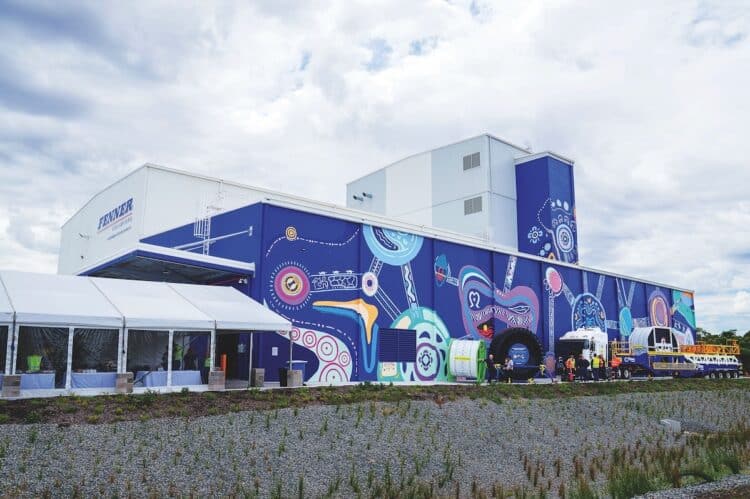
Fenner’s K-MIX hub in Kwinana is driving a circular approach to conveyor belt manufacturing and recycling in mining.
They can be easily overlooked in a mining operation, but conveyor belts are the workhorses of any site, moving ore, coal and bulk materials across vast distances in some of the harshest operating environments on earth.
At Fenner Conveyors’ K-MIX Materials Innovation Hub in Kwinana, Western Australia, those conveyor systems are being rethought from the ground up as products that can live multiple lives.
The facility, officially opened in March, represents a $40 million investment in reshaping how conveyor systems are designed and manufactured in Australia.
For Fenner, the K-MIX Materials Innovation Hub is about redefining the lifecycle of a product long treated as disposable infrastructure. Instead of being discarded during decommissioning, conveyor belts are being repositioned as part of a continuous material loop.
Rather than the traditional linear model of build, use and discard, K-MIX is built around a circular approach that brings used belts back into production through a partnership with Tyrecycle. This shift toward circularity reflects broader changes across the mining sector, according to Fenner executive general manager for sales and marketing Trevor Svenson.
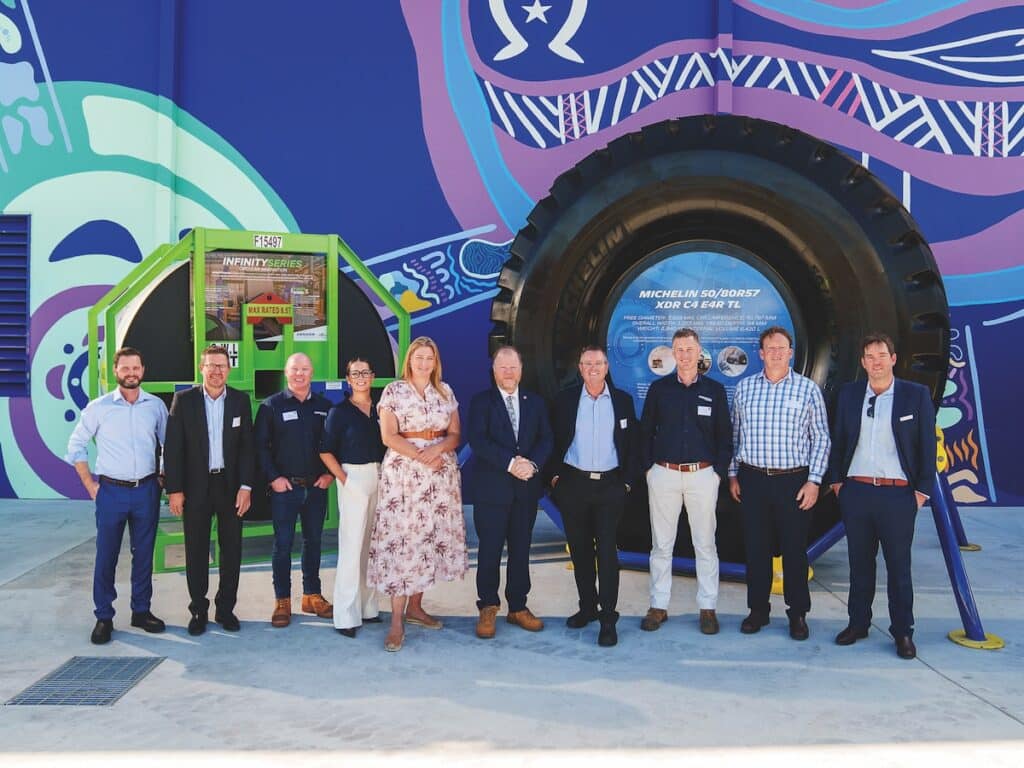
With close to three decades in mining and more than 20 years in equipment sales, original equipment and manufacturer (OEM) supply and service, Svenson has seen the sector’s priorities move toward sustainability, localisation and innovation. That shift is what underpins Fenner’s K-MIX facility.
“The first belt with recycled content that we showcased at our open day was built specifically for a Pilbara customer,” Svenson said. “It’s exciting; it will be the first belt with recycled content going into the iron ore market in the region.”
Development of the K-MIX Materials Innovation Hub was more than a decade in the making, but it was supercharged five years ago when Fenner was acquired by Michelin. This acquisition allowed Fenner to pull more of the value chain onshore and embed innovation directly into production, rather than treating it as a separate function.
“It keeps all our intellectual property in-house, so we’re not outsourcing to third parties,” Svenson said.
The central Kwinana location of the facility also plays a key role.
“[We are] also innovating on the doorstep of our customer base,” Svenson said.
“So we’re able to engage our customers, where they come to the facility and we work with them to develop solutions for their mine site support operations.”
Proximity to customers is a key part of the K-MIX model. Rather than designing products in isolation, Fenner is increasingly co-developing conveyor solutions with mining operators, testing materials and applications in real-time.
A major enabler of the circular system is Fenner’s partnership with Tyrecycle, which processes used conveyor belts and tyres into reusable rubber feedstock at its facility just 3km from the Kwinana site.
This collaboration has been critical in making closed-loop recycling commercially viable at scale.
“What that did was provide a solution for our customers, an end-to-end solution in a sustainable manner,” Svenson said. “We signed a memorandum of understanding to work strategically to deliver circularity for conveyor belt.”
That closeness has also simplified logistics in ways that directly support recycling outcomes. Used belts can be recovered from mine sites, processed nearby and reintroduced into manufacturing without long transport chains or storage delays.
“It just wouldn’t make sense if it was overseas,” Svenson said. “The ability to directly feed product into our mixing facility here absolutely provides from a supply chain and logistical perspective.”
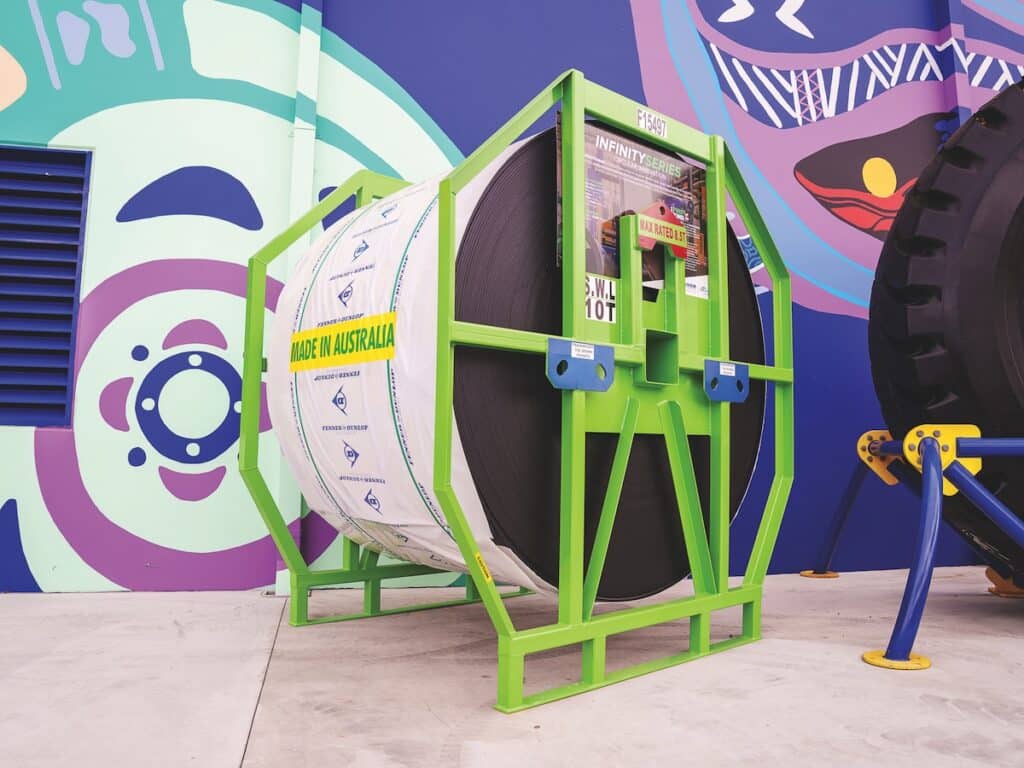
At the heart of the system is the InfinitySeries, Fenner’s new conveyor belt range incorporating recycled content. The material is processed and micronised by Tyrecycle, then compounded by Fenner on site at Kwinana before being reintegrated into new industrial-grade belts.
A key focus of Fenner’s approach is ensuring that circularity does not come at the expense of performance.
“We still have a premium range of belts for critical applications,” Svenson said. “But we’ll be starting to work with our customers to identify conveyors where they require belts, but not to that premium standard.”
Each belt is designed for specific operating conditions, with recycled-content products still engineered for mining environments that demand high abrasion resistance, heavy load capacity and continuous operation. The difference lies in application, not reliability.
“All of these things are tested to meet the relevant standards and full traceability of testing; full chain of custody of all that used belt and where it gets recycled,” Svenson said.
Traceability is a defining feature of the K-MIX system. Every stage of material handling is monitored, from incoming feedstock to final product composition, ensuring customers understand what is in each belt.
“We know exactly the quality of what’s going into our belts,” Svenson said. “Whether it’s belts with no recycled content or part of our InfinitySeries, our customers will know exactly what’s going in there.”
Beyond manufacturing, the system also supports recovery of materials already sitting idle across mining operations.
“Some of those operations have legacy stock that’s been around for 40 years,” Svenson said.
“Being able to do that all locally supports the customer in removing that material and putting it back into downstream markets.”
Fenner’s broader ambition is to extend circular manufacturing across Australia’s major mining regions, not just in Western Australia.
Fenner and Tyrecycle are already rolling out programs in Queensland, with further expansion planned for mining ore regions such as the Bowen Basin and the Hunter Valley in New South Wales.
“There’s a number of other products in our portfolio that we’re exploring options for circularity with Tyrecycle,” Svenson said.
“We’re already embarking on our first recycling delivery model with a port in north Queensland.”
As these initiatives expand, the implications extend beyond individual sites. Circular systems such as K-MIX point to a model where materials, logistics and manufacturing are more tightly integrated across the mining value chain, reducing waste while improving supply chain resilience
The shift is as much structural as it is cultural, Svenson said, embedding manufacturing, mining and recycling into a single interconnected system that is still evolving.
In that sense, K-MIX is less about a single facility and more about a different approach to industrial materials, one in which even the most hard-wearing components are no longer destined for a single life, but for many.
This feature appeared in the June 2026 issue of Australian Mining magazine.